Why chasing trends and cultural relevance is flattening brand identity instead of defining it
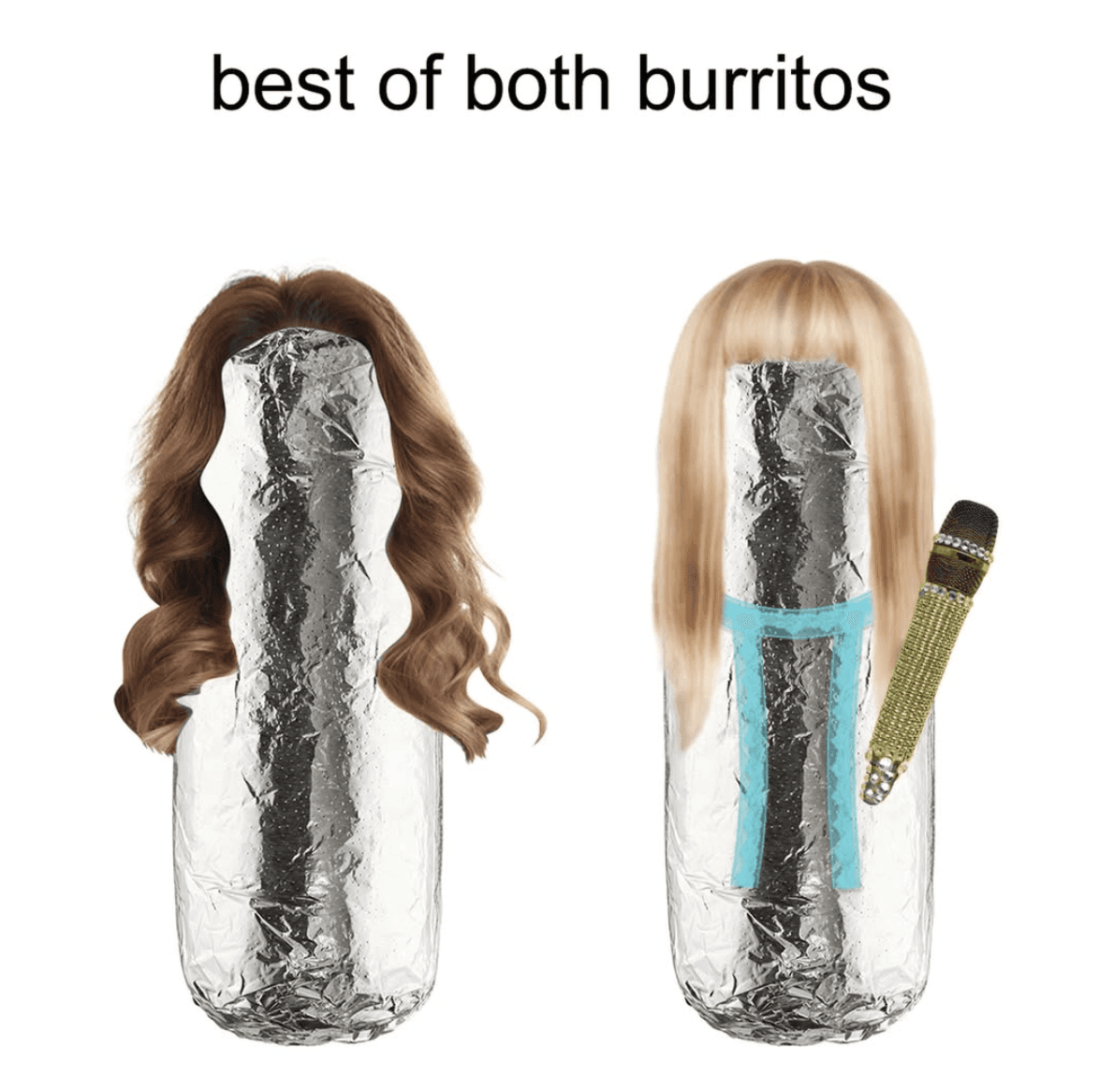
As a proud Zillennial (‘00), I can’t exactly be mad about the Hannah Montana burrito. But watching brands insert themselves into every pop culture moment has made me think more critically about what we keep calling “brand personality.”
No matter what’s happening in culture, brands are watching. And if their audience is talking about it, they want in. That instinct makes sense. But at some point, participation stops looking like personality and starts looking like a reach for relatability.
Every brand is in the comments section. Every brand is in on the joke.
Now they often seem to be performing for each other as much as for their audience. Scroll any TikTok or Instagram feed and it’s brands responding to other brands, responding to the same viral clips, and so on.
This looks like personality. It feels human. But it’s not actually identity. It’s performance.
When This Worked (And Why)
It didn’t always used to be like this. Some of us will remember the early examples of brands challenging the status quo on social media. One of the most iconic examples of this is the Wendy’s Twitter account.
Wendy’s is known for being sassy and sarcastic on Twitter, for using savage humor, satire, and making fun of other brands and users online, positioning the brand as a distinct voice in the fast food industry.
The reason it worked is that it didn’t feel borrowed.
Chasing a Trend v. Setting A Trend
When Wendy’s built its voice on social media, it did something a lot of brands still fail to do now: it created behavior that felt specific to the brand.
The tone was unexpected for the category, but it wasn’t random. The sarcasm, the roasting, the confidence, all of it made Wendy’s feel distinct in a sea of interchangeable fast food marketing. More importantly, it wasn’t just trying to sound online. It was reinforcing a broader identity built around boldness, confidence, and a willingness to challenge competitors directly.
That is very different from today’s trend-driven brand behavior. Wendy’s wasn’t jumping into culture to prove it was relatable. It was shaping a recognizable presence of its own.
Everyone Looks The Same Now
What was once a differentiator has become a default.
Other brands looked to the early pioneers in brand personality as social media and digital spaces grew. Soon it wasn’t just Wendy’s serving up a plate of brand personality. Everyone was. And when everyone is eating at the same buffet, those brand personalities all start to look alike.
The pattern is obvious. Brands now share the same tone: ironic, self-aware, slightly unhinged. They share the same behavior too: trend-jacking, comment lurking, and rushing into the same conversations at the same time. The result is not personality.
It’s sameness; It looks like this:

A perfect and recent example of this is the viral Dr. Pepper jingle. A TikTok creator, Romeo, posted a video in late 2025 singing what she thought would be a good jingle for a Dr. Pepper commercial.
The video went viral, amassing over 125 million views across platforms, and garnering the attention of brands seeking to be in on the conversation.
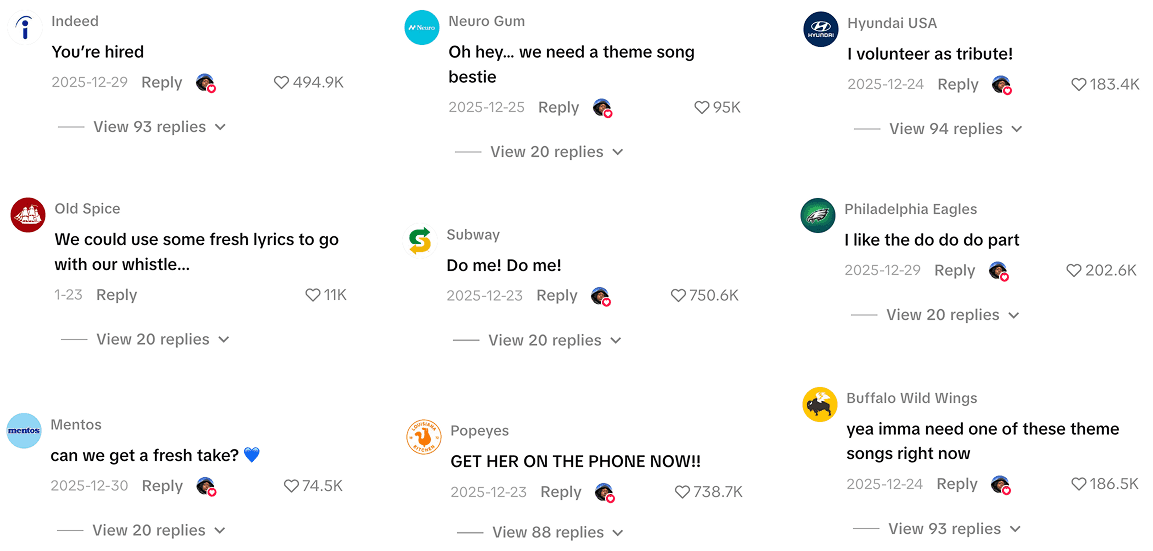
You’ll notice reading these comments, they all look and sound pretty similar. The problem is if everyone sounds relatable in the same way, no one has a personality.
Why Brands Do This
It’s easy to see this and think brands are just trying too hard.
But the reality is more practical than that. Relatability works (at least in the short term). It gets the engagement they want, it’s fast, it’s visible, and it’s measurable.
A clever comment or a post that feels timed just right to be relevant to something in pop-culture can create immediate engagement. Likes, comments, and shares are all signals that something is “working.”
According to HubSpot’s State of Marketing Report from 2023, nearly 63% of social media marketers reported that relatable content is the best performing content for their brand followed by trendy content (59%).
For marketing and social media teams performing under pressure, that feedback loop is hard to ignore.
Blending in is also relatively safe. When brands adopt the same personality traits as everyone else, they fit into a mold that their audiences already understand. They don’t stand out, but they avoiding alienating anyone.
Personality requires decisions, perspective, and sometimes even restraint, but relatability only requires participation. That’s it. You don’t need a clear point of view to hop on the bandwagon; You just need to be in the right place at the right time.
That may be effective, but it’s not the same thing as strategy.
Personality is harder. It takes consistency across touchpoints, alignment with a broader brand system, and a willingness to not engage with everything.
The easier path usually wins.
What Real Brand Personality Looks Like
It doesn’t have to be like this. There’s an alternative.
Real personality shows up as consistent perspective, not just voice and tone; opinions, not just participation; boundaries, and what a brand doesn’t engage with; and overall behavior across touchpoints, not just social media.
An effective brand identity should be distinguishable. If you go back up to the image of comments left on Romeo’s TikTok and remove the logos and handles, would you be able to tell which brand wrote which comment? Maybe one or two.
There’s also no need for all those brands to be there. If they saw this viral video and were truly interested in having a jingle created for their own brand, their people would get in touch with Romeo privately. The purpose of the comment isn’t about business, identity, or personality. It’s about visibility and relatability.
A brand with personality doesn’t need to be everywhere. It just needs to be recognizable anywhere.
What’s At Risk If You Confuse The Two
It may seem like this isn’t that big a deal. After all, according to HubSpot, 63% of social media marketers say relatable content performs the best, so what’s the harm?
Mistakes
One risk is that brands become so eager to participate that they don’t even fully understand the references they’re making. In the comment section of Chipotle’s Hannah Montana burrito post, one grocery brand quoted lyrics from a Hilary Duff song instead.
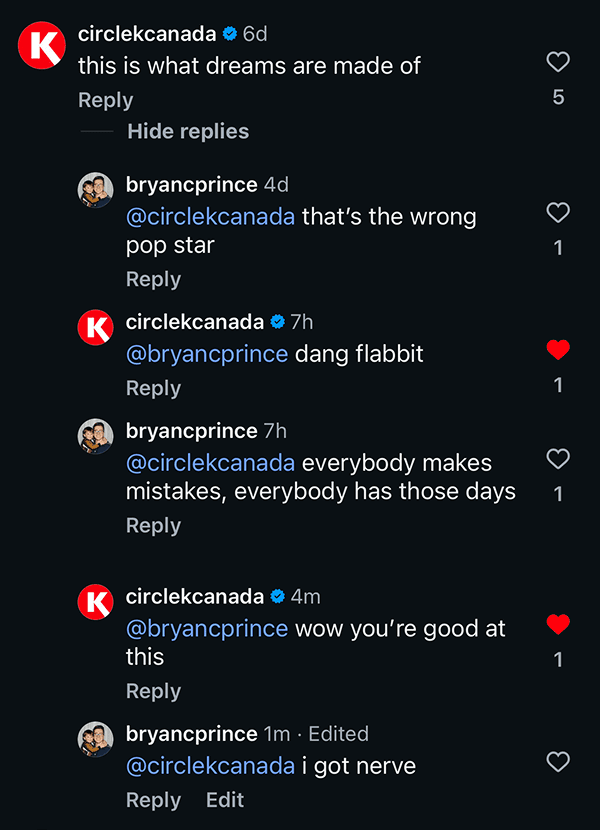
On its own, that kind of mistake is minor. But it reveals something bigger: the brand wasn’t contributing from a place of identity or relevance. It was reaching for cultural proximity.
That is the danger of performative relatability. The goal is not to say something meaningful or recognizable. It is simply to be seen participating.
Memorability
The Marketing Rule of 7 claims that it takes approximately seven times of a prospect seeing or hearing a brand’s messaging before they make a purchasing decision. This concept is from the 1930s, well before modern consumers were bombarded with ads and content from every angle at every second of the day.
Businesses are in constant competition for attention. As the volume of content increases, and as AI accelerates the production of bland, interchangeable content, distinctiveness will matter even more.
HubSpot also says “As AI floods the market with content, brands without a clear point of view are getting lost. In 2026, growth is increasingly driven by distinctiveness, trust, and relevance.”
Relatable and trendy content might perform well, but the cost of short-term engagement is long-term forgetability. Awareness of your brand without distinction or point of view doesn’t convert.
The Takeaway
Relatability isn’t the problem. It can be effective and engaging. In the right context, it can be used to reinforce a brand.
But it was never meant to carry the weight of an entire identity.
What we’re seeing now isn’t brands becoming more human. It’s brands becoming more the same. Same tone. Same timing. Same instincts about what to say and when to say it. And the more this behavior gets mistaken for personality, the harder it becomes for any brand to actually stand apart.
You can’t build personality in a single moment. It’s built through recognizable patterns. It shows up in what a brand chooses to engage with, what it ignores, how it speaks when no one is watching, and how consistent it remains when trends move on. It’s not about being in every conversation. It’s about being recognizable in any one of them.
The goal isn’t to feel relatable to everyone. It’s to be specific enough that the right people recognize you instantly. And that requires more than showing up. It requires a point of view.
More Articles
A collection of recent articles spanning brand strategy and positioning, brand design, and more.